
Introduction to AI/ML System Design

The AI system design interview is very different from a standard technical interview round like coding. It's an open-ended conversation that copies a real-world design meeting. It tests your ability to turn a vague business need into a practical, large-scale intelligent system.
To succeed, you must change your mindset. Instead of focusing only on one perfect solution or a perfect model to use, you must focus on the entire system. The machine learning model, while important, is just one part of a much larger, more complex system built to deliver business value. The real product is the end-to-end system itself.
Interviewers at top tech companies are not just testing your knowledge of algorithms. They are testing if you have the skills to be a future senior colleague and technical leader. This evaluation is based on three key skills that separate a great answer from an average one.
Structured Thinking: You must be able to break down a complex problem into a series of logical, manageable steps. A clear, step-by-step approach shows the interviewer how you think and proves you have a disciplined engineering mindset.
Proactive Clarification & Scoping: The most common mistake is to jump into solutions too quickly without fully understanding the problem's context and limits. A great candidate takes charge. They ask smart questions to define the system's scope, requirements, and success criteria. This initial conversation is not just a warm-up; it shows leadership and strategic thinking.
Trade-off Analysis: Every design choice has pros and cons. Senior engineers explain the why behind their choices by openly discussing real-world limits like speed (latency), scale, cost, privacy, and maintainability. Showing you understand these trade-offs is a clear signal that you have real-world experience.
This interview is like a team meeting to solve a problem. It is similar to how senior engineers lead discussions: They define the problem, suggest a high-level design, discuss the trade-offs of different parts, and agree on a path forward. Therefore, your main goal is to lead this discussion.
Think aloud. Treat the interviewer as a teammate. And use the framework in this guide as a flexible outline—not a strict script. This is the core strategy for success. The interviewer will be grading you on several key areas:
How you explore the problem, your data and feature strategy,
Your reasons for choosing a model,
Your plan for putting it into production, and
Your overall communication.
This guide gives you a complete method to do well in all these areas.
The 3×3 Method for AI System Design Interviews
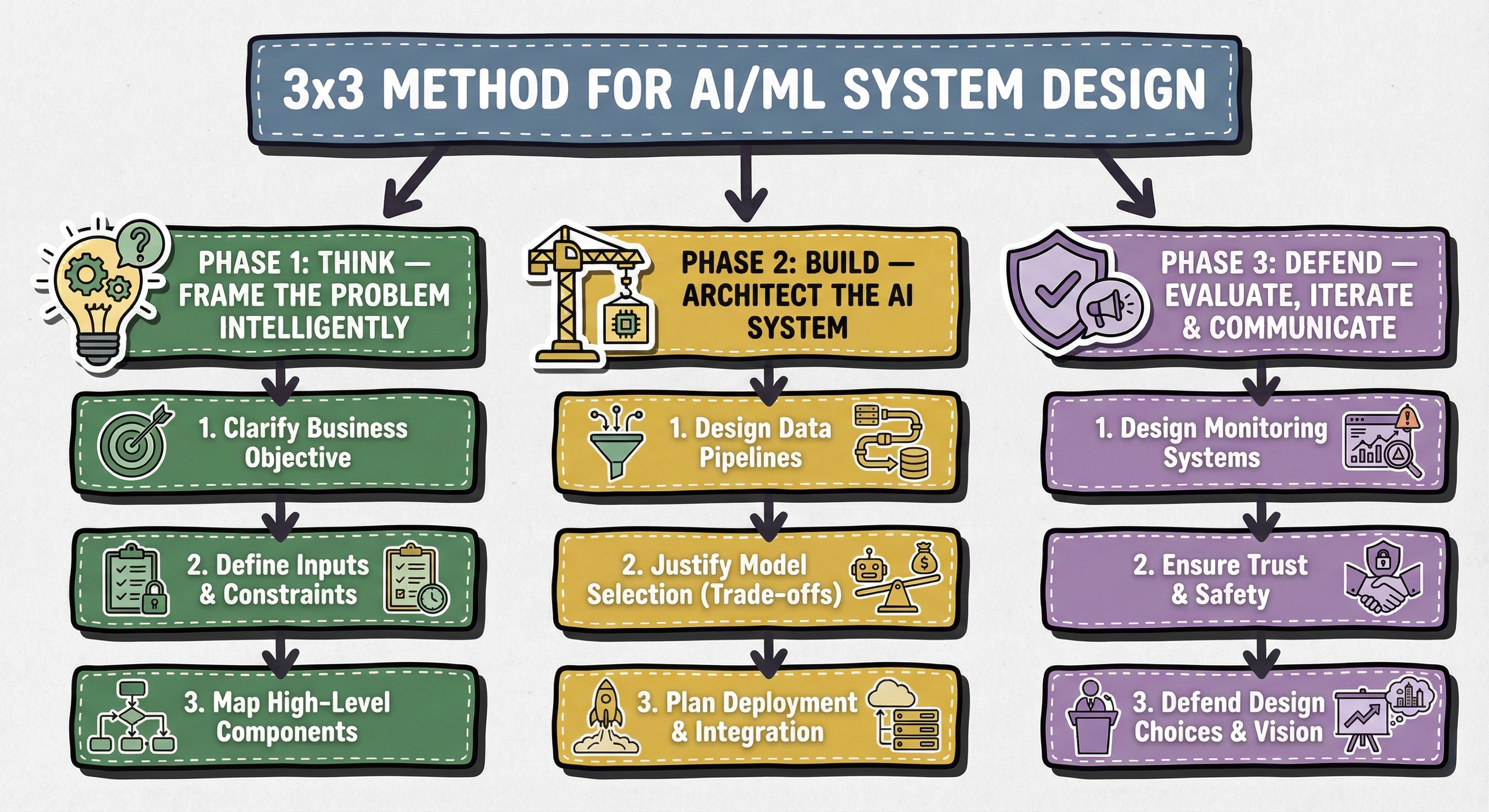
The 3x3 Method is a framework for structuring your approach to an AI system design interview. It is designed to move you away from a narrow, model or algorithm only mindset and toward building a complete, end-to-end system that delivers business value.
Is this the only way to ace AI/ML system design interviews? Of course not. But what this method does well is provide a memorable structure you can lean on throughout the interview.
You will find the 3x3 method intuitive because its three core phases—Think, Build, and Defend—mirror the natural, logical progression of a real-world engineering project, guiding you from defining the problem to executing the solution and finally owning the lifecycle. This structured approach replaces an overwhelming "laundry list" of potential steps with logical blocks, which significantly reduces your cognitive load when you are feeling nervous in an interview. By grouping related tasks together, the framework ensures that even if stress causes you to forget a specific step, you can easily recover your flow by simply moving to the next logical block within that phase. The "3x3" name itself suggests a contained, manageable matrix of nine distinct steps, making the entire complex process feel less daunting and easier for you to recall under pressure. Ultimately, the method acts as a flexible mental map for you rather than a strict script, allowing you to focus on leading the open-ended conversation like a smart engineer instead of anxiously trying to remember disjointed items.
The name 3x3 comes from the fact that the method is divided into three main phases, each containing three steps, which guide you from a vague business problem to a fully-realized, defensible, and production-ready system.
The three core phases are:
Phase 1: THINK — Frame the Problem Intelligently This initial phase is about leadership and clarification. Before diving into how to build anything, you must first understand the why and the what. This involves clarifying the business objective, defining the inputs and constraints, and mapping out the high-level components.
Phase 2: BUILD — Architect the AI System This is the technical deep-dive where you architect the system's "factory." You'll show your technical depth by designing the data pipelines, justifying your model selection as a series of trade-offs, and planning the deployment and integration strategy to bring the model to life at scale.
Phase 3: DEFEND — Evaluate, Iterate & Communicate This final phase demonstrates senior-level maturity. After the system is "built," you must prove you can own it for its entire lifecycle. This involves designing monitoring systems, ensuring trust and safety, and confidently defending your design choices while showing a clear vision for future iterations.